
Course
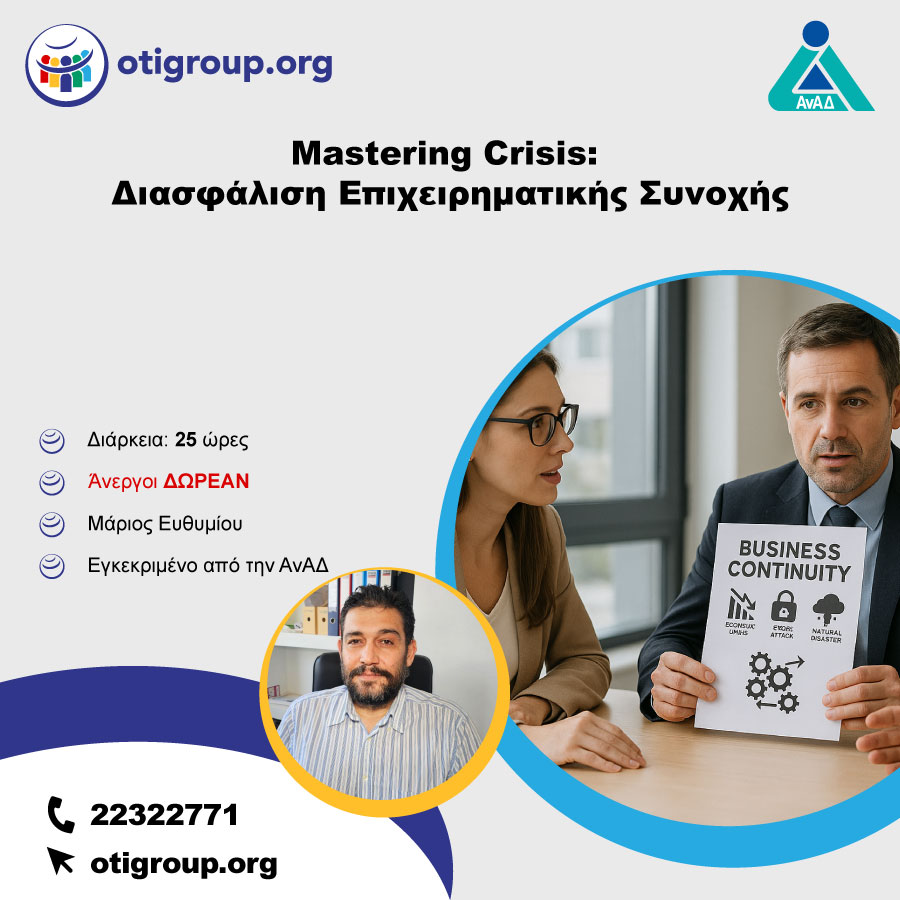
Mastering Crisis: Ensuring Business Cohesion
Mastering Crisis: Ensuring Business Cohesion
About this course
In a world full of unpredictable challenges such as economic crises, cyberattacks and natural disasters, business continuity is crucial for survival and growth. Our program offers the necessary tools and knowledge for effective crisis management, risk assessment and development of contingency plans.
With practical exercises and case studies, you will learn how to reduce downtime, protect your business reputation, and ensure resilience in the competitive business world.
Crisis management: economic, cyberattacks, natural disasters.
Business continuity planning and implementation.
Assessment and management of operational risks.
Development of emergency plans and crisis communication.
Practical exercises and case studies to enhance resilience.
Strengthening leadership skills and promoting team collaboration in critical moments.
Continuous improvement and updating of crisis management plans.
Equip yourself with the skills you need to keep your business operational even in the most difficult situations!
Who it is for
Leaders, managers, team leaders, SME owners and HR professionals responsible for managing operations and ensuring business continuity.
Ideal for those working in industries with a high risk of disruption, without requiring prior experience in crisis management.
Ideal for those working in industries with a high risk of disruption, without requiring prior experience in crisis management.
Objectives
To equip participants with knowledge to identify and categorize crises, understand and implement business continuity plans, and develop effective crisis response strategies.
At the same time, it strengthens skills in risk analysis, crisis communication and designing practical solutions, promoting a culture of proactive management and teamwork.
At the same time, it strengthens skills in risk analysis, crisis communication and designing practical solutions, promoting a culture of proactive management and teamwork.
Methodology
The methodology of our training programs is based on a modern, participatory and experiential approach, adapted to the needs of the participants. We combine theoretical knowledge with practical applications, utilizing interactive tools, group activities and case studies. Teaching is done by specialized trainers.
Course content
Introduction to Crisis Management: definitions, types of crises, impacts.
Risk Assessment & Impact Analysis: identification, classification, prioritization.
Crisis Response Strategy Development: protocols, roles, team management.
Crisis Communication Planning: internal/external communication, media, social media.
Business Continuity Planning: critical operations, outage reduction, recovery.
Simulations & Role Playing: practical application, decision making, communication.
Case Studies & Workshops: analysis of real crises, strategies.
Review & Evaluation: repetition, final tests, improvement of strategies.
Funding
Upon successful completion of the program, a certificate of attendance recognized by the HRDA (EQF5) is issued.
The grant from the HRDA is subject to conditions and requires 75% participation in the total duration of the program.
The grant from the HRDA is subject to conditions and requires 75% participation in the total duration of the program.
Upcoming implementations
No implementation is currently scheduled. You can still enquire about this course.